Skip to content
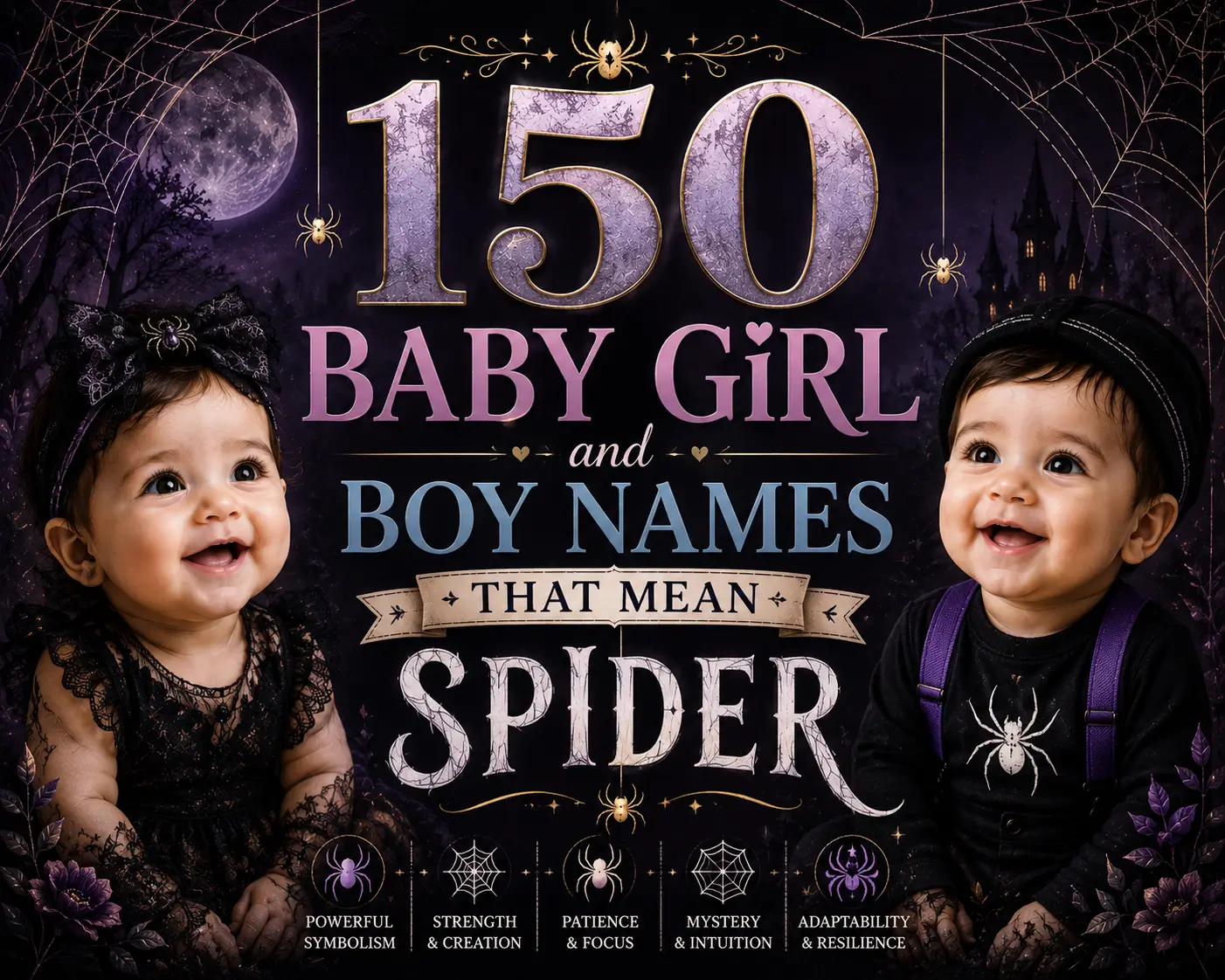

A spider does not chase the world. It creates its own. Thread by thread, it builds something delicate enough to shimmer in the light and strong enough to survive the storm. That symbolism is what makes spider-inspired names feel so unforgettable. They carry meanings tied to creativity, patience, cleverness, mystery, and quiet power, perfect for parents looking for a name that feels rare in every way.
Key Takeaways
- Spiders symbolize creativity, patience, and wisdom across dozens of world cultures.
- Names rooted in spider mythology come from Greek, Japanese, African, Native American, Sanskrit, Welsh, and many other traditions.
- Many of these names work beautifully as first names, middle names, or even last names.
- Japanese spider names often carry an elegant, musical sound that translates well in English-speaking countries.
- Several names here connect to weaving and web-spinning, making them meaningful for families with a love of textile arts or crafts.
Girl Names That Mean Spider
These names are drawn from mythology, folklore, world languages, and the natural world. Each one carries a distinct origin and a meaning tied to spiders, webs, weaving, or spider-associated deities.
| Name | Origin | Meaning |
|---|---|---|
| Arachne | Greek | Directly means “spider”; the mortal weaver transformed by Athena in Greek mythology |
| Aranya | Sanskrit | Means “forest dweller” or “spider”; tied to the wilderness and mystery |
| Aranea | Latin | Directly means “spider”; associated with web-spinning and intricate design |
| Corryn | Welsh | Means “spider”; a rare and beautiful Celtic choice |
| Uttu | Sumerian | The goddess of weaving whose name translates to “spider” |
| Neith | Egyptian | Goddess of weaving and war; the spider was her sacred symbol |
| Penelope | Greek | Means “weaver”; the faithful wife in Homer’s Odyssey who wove and unwove a shroud |
| Argiope | Greek | Means “silver-faced”; a genus of orb-weaving spiders |
| Gossamer | English | Refers to the fine silk threads spiderlings use to travel through air |
| Jorogumo | Japanese | Means “binding bride”; a legendary spider-woman yokai from Japanese folklore |
| Hersilia | Latin/Spider | A long-spinnered bark spider genus; elegant and rare as a given name |
| Maevia | Latin | A genus of jumping spiders; used as a given name in ancient Rome |
| Kaira | Greek | A type of orb-weaving spider; also means “right time” in other traditions |
| Larinia | Latin | A genus of orb-weaving spiders; soft and lyrical as a name |
| Aganippe | Greek | Means “gentle horse” in Greek; also a spider genus resembling a tarantula |
| Argiela | Greek/Modern | Creative variation of Argiope; carries the “silver” root meaning |
| Aranthea | Greek | A lyrical elaboration on Arachne; means “spider” with an elegant sound |
| Webelia | English/Modern | A creative blend of “web” and “Elia”; symbolizes interconnectedness |
| Lyrissa | English/Modern | Combines lyrical grace with the elegance of spider silk |
| Merimange | Albanian | The Albanian word for spider; striking and exotic as a name |
| Araignee | French | The French word for spider; poetic and sophisticated |
| Arana | Spanish | The Spanish word for spider; smooth and wearable as a given name |
| Anansia | Akan/West African | The feminine form of Anansi; means “spider” in the Akan language |
| Maengmum | Thai | Directly means “spider” in Thai; associated with a famous Thai actress |
| Tsuchika | Japanese | Inspired by Tsuchigumo, the earth spider of Japanese mythology |
| Higanbana | Japanese | Means “red spider lily”; a flower deeply tied to Japanese spider folklore |
| Kumiko | Japanese | Means “child of eternal beauty”; poetically associated with spider web artistry |
| Aranta | Welsh/Modern | A softer variant of the Welsh Corryn root; means “spider-like” |
| Minerva | Roman | The goddess of wisdom and weaving, closely linked to spider symbolism |
| Filistata | Latin | A genus of carnivorous, fanged spiders; bold and distinctive as a name |
| Nettia | English/Modern | Inspired by “net”; evokes the delicate structure of a spider’s web |
| Silkara | English/Modern | Combines “silk” with a feminine suffix; honors the spider’s finest craft |
| Aracella | Greek/Modern | A softer, more wearable take on Arachne; means “little spider” |
| Webrielle | English/Modern | A playful feminine blend of “web” and a classic name ending |
| Spindra | English/Modern | Combines “spin” with a feminine ending; celebrates the spider’s spinning nature |
| Cecina | Latin/Spider | A subtle nod to Cecinda, a type of comb-footed spider found in tropical regions |
| Aranka | Hungarian/Greek | A Hungarian form with Greek roots meaning “spider”; also means “golden” |
| Araniella | Latin | A type of orb-weaving spider; delicate and botanical-sounding |
| Tibella | Latin | Inspired by Tibellus, the slender crab spider; graceful and rare |
| Marvella | English | Means “marvelous”; associated with the astonishing craft of a spider’s web |
| Waverly | English | Blends the idea of “weaver” with a lyrical sound; creative and bookish |
| Zelara | Greek/Modern | Inspired by Zelotes, a ground spider; sounds celestial while keeping the spider root |
| Thalira | Greek | A rare feminine form drawing from spider-associated Greek mythology |
| Sericella | Latin | From “sericeus” meaning “silky”; refers to the silk of a spider’s web |
| Orbella | Latin | From “orb-weaver”; a spider that builds the classic circular web |
| Noctara | Latin/Modern | From “noctua” meaning “night”; many spiders are nocturnal hunters |
| Venara | Latin | From “venator” meaning “hunter”; celebrates the spider as a skilled predator |
| Arctosa | Greek | A genus of wolf spiders; strong, grounded, and rare as a name |
| Luxa | Latin/Spider | Inspired by Lutica, an ant spider; short, crisp, and modern |
| Gladicosa | Latin | A genus of wolf spiders; bold and powerful for a baby girl |
| Lirinea | Latin/Modern | A soft elaboration on Larinia, the orb-weaver spider genus |
| Camarella | Latin/Modern | Inspired by Camillina, a ground spider genus; warm and wearable |
| Cerocida | Latin | A tropical spider found in South America; exotic and one-of-a-kind |
| Celsia | Latin/Spider | Inspired by Clubiona, a leafcurling sac spider; sounds fresh and modern |
| Corinela | Welsh/Modern | A feminine elaboration on Corryn, the Welsh word for spider |
| Evarcha | Latin | A genus of jumping spiders; energetic and spirited as a name |
| Ghelna | Latin | A genus of jumping spiders; short and memorable |
| Marpina | Latin/Modern | Inspired by Marpissa, a jumping spider genus; has a quick, bright sound |
| Zosia | Latin/Greek | Drawn from Zosis, a non-venomous spider genus; playful and Eastern European in feel |
| Fiora | Latin/Spider | Inspired by Filistata; combines the spider root with a nature-feel ending |
| Andastia | Latin | Inspired by Andasta, a ray spider; rare, ancient, and beautiful |
| Bromelia | Latin | A hackled band-producing spider genus; sounds botanical and lovely |
| Cesonara | Latin/Modern | A feminine elaboration on Cesonia, a ground spider genus |
| Agynara | Latin/Modern | From Agyneta, a sheet-weaver spider; flows easily off the tongue |
| Agelinda | Latin/Modern | Inspired by Agelena, a funnel web-weaving spider; sounds warm and storied |
| Silkena | English/Modern | A lyrical variation on “silk”; honors the spider’s most remarkable product |
| Ninguta | Greenlandic | Derived from Níngut, which means “spiderweb” in Greenlandic |
| Arctara | Greek/Modern | A modern elaboration on Arctosa, the wolf spider genus |
| Orbiana | Latin | A regal, elaborate feminine form drawn from “orb-weaver” |
| Wabassa | Algonquin | Inspired by Wabasso, a sheet-weaving spider with indigenous roots |
Boy Names That Mean Spider
These boy names draw from mythology, ancient languages, spider genera, and world cultures. Every name here is distinct and carries a clear connection to spiders, webs, or related symbolism.
| Name | Origin | Meaning |
|---|---|---|
| Anansi | Akan/West African | Means “spider” in the Akan language; the beloved trickster spider of West African folklore |
| Kumo | Japanese | Directly means “spider” in Japanese; gender-neutral but widely used for boys |
| Iktomi | Lakota/Native American | The Lakota trickster spider deity; a powerful name from indigenous North American tradition |
| Cancor | Old High German | Means “spider” in Old High German; rare, sharp, and strong |
| Araneus | Latin | The scientific genus name for spiders; historically used as a given name |
| Ariamnes | Greek | A cobweb spider genus; in Greek lore the name relates to a spider’s cord |
| Dolomedes | Greek | Means “deceitful, wily” in Greek; a genus of large fishing spiders |
| Webster | English | Means “weaver”; one of the oldest English occupational surnames |
| Weaver | English | A direct English occupational name meaning “one who weaves” |
| Anansis | Akan/Modern | A slightly modified masculine form of Anansi; still carries the spider root |
| Tsuchigumo | Japanese | Means “earth spider”; a powerful creature from Japanese mythology |
| Unktomi | Lakota | An alternative spelling of the Lakota trickster spider; means “spider” |
| Aranos | Greek/Modern | A masculine form blending Araneus with a Greek name ending |
| Arakar | Sanskrit/Modern | A masculine elaboration on Aranya; means “forest spider” |
| Gossam | English/Modern | A masculine short form of Gossamer; evokes silk and lightness |
| Spinward | English/Modern | Means “moving in the direction of spinning”; creative and forward-looking |
| Cobren | English/Modern | A modern masculine blend of “cobweb” and a strong name ending |
| Atrax | Greek | A genus of highly venomous funnel-web spiders; bold and commanding |
| Sicarius | Latin | Means “assassin” in Latin; also a genus of desert spiders known for potent venom |
| Zelotes | Greek | A ground spider genus; also connected to the Greek word for “zealous, devoted” |
| Tartarus | Greek | A cave-dwelling spider genus; also a primordial deity of the Greek underworld |
| Thanatus | Latin | A false crab spider genus; linked to Thanatos, the Greek god of peaceful death |
| Bagheera | Sanskrit/Spider | A jumping spider genus; made famous as the panther in The Jungle Book |
| Cantuario | Latin/Modern | A masculine take on Cantuaria, a tarantula-like spider from New Zealand |
| Catumiro | Latin/Modern | Inspired by Catumiri, a South American tarantula genus |
| Wabasso | Algonquin | A sheet-weaving spider with strong indigenous roots; rare and storied |
| Aragon | Latin/Modern | Subtly drawn from Araneae; strong and memorable with a hint of royalty |
| Aranok | Latin/Modern | A crisp masculine blend of Araneus with a hard consonant ending |
| Nephilim | Hebrew/Spider | Nephila is a golden silk orb-weaver; Nephilim carries mythic weight |
| Spindon | English/Modern | Combines “spin” with a strong masculine ending; energetic and unique |
| Orbix | Latin/Modern | From “orb-weaver”; sleek, modern, and science-inspired |
| Korgul | Fantasy/Modern | Inspired by spider lore in fantasy tradition; bold and otherworldly |
| Zodorin | Latin/Modern | A masculine elaboration on Zodarion, an ant-eating spider genus |
| Tenarion | Latin/Modern | Inspired by Tenedos, an ant spider; sounds ancient and noble |
| Theridon | Latin/Modern | From Theridion, a tangle-web spider genus; has a scholarly, distinct sound |
| Agelian | Latin/Modern | A strong masculine form drawn from Agelena, the funnel web spider |
| Allocen | Latin/Modern | From Allocosa, a wolf spider; sounds powerful and mythological |
| Galeomar | Latin/Modern | A bold masculine name inspired by Galeosoma, a tarantula-like spider |
| Dolomex | Greek/Modern | A sharp modern masculine blend of Dolomedes with a strong ending |
| Argioph | Greek/Modern | A masculine take on Argiope; carries the “silver-faced” meaning |
| Corryn | Welsh | Means “spider” in Welsh; works equally well as a boy’s name |
| Mangoran | Latin/Modern | From Mangora, an orb-weaving spider; has a strong, rolling sound |
| Ariamnis | Greek/Modern | A masculine variant of Ariamnes, the cobweb spider genus |
| Atraxis | Greek/Modern | An elaborated form of Atrax, the venomous funnel-web spider genus |
| Zeloric | Greek/Modern | A stronger masculine elaboration of Zelotes, the “zealous” ground spider |
| Sicaren | Latin/Modern | A softened masculine variant of Sicarius, the desert assassin spider |
| Taranos | Latin/Modern | Drawn from Taranto, the Italian city that gave tarantulas their name |
| Hexuran | Latin/Modern | From Hexura, a sheet funnel-web spider; rare and science-forward |
| Wableron | Algonquin/Modern | A creative masculine expansion of Wabasso, the sheet-weaver spider |
| Cataxon | Latin/Modern | From Cataxia, a large tarantula-like spider; powerful and uncommon |
| Cerocidan | Latin/Modern | A bold masculine form of the tropical spider genus Cerocida |
| Bromellian | Latin/Modern | A strong masculine take on Bromella, the hackled band-producing spider |
Unisex Names That Mean Spider
These names work for any child regardless of gender. They draw from various languages and traditions where spider symbolism is strong.
| Name | Origin | Meaning |
|---|---|---|
| Silk | English | Refers to spider silk; elegant, simple, and wearable for any gender |
| Ara | Greek | A short form of Arachne and Aranea meaning “spider” |
| Arania | Persian | Means “spider” in Persian; melodic and cross-cultural |
| Anansi | Akan | The West African spider trickster name works beautifully for any gender |
| Spinner | English | Refers to the spider’s core act; lively and creative |
| Orbis | Latin | From “orb-weaver”; means “circle” or “world” and honors the spider’s round web |
| Silkan | English/Modern | A modern unisex form of Silk; adds a slight surname quality |
| Ningut | Greenlandic | Means “spiderweb”; rare, soft, and genuinely cross-cultural |
| Ketu | Sanskrit/Hindu | A Hindu mythological name linked to the web of fate; unisex in modern use |
| Weban | English/Modern | A modern unisex blend meaning “one of the web” |
Japanese Names That Mean Spider or Spider Lily
Japanese names carry a lyrical beauty that makes them stand out even in English-speaking countries. Several of these connect to the red spider lily, a striking autumn flower deeply woven into Japanese folklore.
| Name | Origin | Meaning |
|---|---|---|
| Kumo | Japanese | Means “spider”; the purest Japanese word for the creature |
| Kumiko | Japanese | Means “child of eternal beauty”; poetically tied to the intricacy of spider webs |
| Higanbana | Japanese | Means “red spider lily”; a flower symbolizing final farewell and rebirth |
| Jorou | Japanese | Short masculine form of Jorogumo, the spider-woman yokai |
| Jorouha | Japanese | A lyrical feminine form of Jorogumo; means “binding, weaving woman” |
| Tsuchiro | Japanese | A masculine shortening inspired by Tsuchigumo, the earth spider warrior |
| Kumira | Japanese/Modern | A soft feminine form of Kumo meaning “child of the spider’s grace” |
| Kumoha | Japanese/Modern | Feminine form meaning “leaf of the spider”; fresh and nature-inspired |
| Higano | Japanese | A masculine form drawn from Higanbana, meaning “of the spider lily” |
| Yomotsu | Japanese | Connected to Yomi, the Japanese underworld where spider spirits dwell |
Greek Names That Mean Spider
Greek mythology gave the world its most enduring spider story in Arachne, but the language is rich with related names beyond that single famous weaver.
| Name | Origin | Meaning |
|---|---|---|
| Arachne | Greek | Means “spider”; the original mythological weaver |
| Argiope | Greek | Means “silver-faced”; a striking orb-weaver spider genus |
| Dolomedes | Greek | Means “wily, deceitful”; a large fishing spider genus |
| Agelena | Greek | A funnel web-weaving spider genus; means “gathering together” |
| Ariamnes | Greek | A cobweb spider; the name carries connotations of spider cord and line |
| Eris | Greek | A jumping spider genus; also the goddess of discord |
| Kairos | Greek | Related to Kaira, the orb-weaving spider genus; means “the right moment” |
| Aranthis | Greek | A lyrical masculine elaboration on Arachne; means “spider-born” |
| Aganippe | Greek | A tarantula-like spider genus; also a spring sacred to the Muses |
| Arachnor | Greek/Modern | A powerful masculine elaboration meaning “strength of the spider” |
Last Names / Surnames That Mean Spider
Some families prefer to honor spider symbolism in a surname-inspired way, either using these as middle names or choosing them as surnames with cultural intent.
| Name | Origin | Meaning |
|---|---|---|
| Webster | English | Occupational surname meaning “weaver”; one of England’s oldest spider-related names |
| Weaver | English | An English occupational surname directly tied to weaving |
| Spinner | English | An old occupational surname for one who spins thread or silk |
| Arachnor | Greek | A strong surname-style name meaning “of the spider” |
| Cancoran | Old High German | An elaborated form of Cancor, meaning “of the spider family” |
| Silkmore | English/Modern | A modern compound surname blending “silk” with “more”; evokes refinement |
| Cobren | English/Modern | A modern surname-style name from “cobweb” and a surname ending |
| Webmore | English/Modern | A compound name blending “web” with a classic English suffix |
| Aranol | Latin/Modern | A distinguished surname-style name from Araneus |
| Aranfeld | German/Modern | A Germanic surname blend meaning “spider field” |
Rare and Unique Names That Mean Spider
These are the rarest picks on the list, names you will almost certainly never hear on another child. They draw from obscure mythology, niche linguistic roots, and creative elaborations.
| Name | Origin | Meaning |
|---|---|---|
| Merimange | Albanian | The Albanian word for spider; genuinely rare outside Albania |
| Ninguta | Greenlandic | Means “spiderweb” in Greenlandic; almost entirely unused as a given name |
| Arania | Persian | Persian word for spider; melodic and virtually unknown in Western naming |
| Corryn | Welsh | Welsh word for spider; rare even in Wales |
| Cancor | Old High German | Old High German for spider; one of the rarest on this entire list |
| Unktomi | Lakota | The Lakota trickster spider; carries deep indigenous spiritual weight |
| Tsuchiro | Japanese | Drawn from the earth-spider myth; rare even in Japan |
| Arankha | Sanskrit/Modern | A creative feminine Sanskrit elaboration meaning “born of the forest spider” |
| Zeloric | Greek/Modern | A bold elaboration on Zelotes; no documented use as a given name |
| Cerocidan | Latin/Modern | Based on a spider found only in tropical South America; truly one-of-a-kind |
Mommy Labs Spider Names for Baby Girls and Boys
| Name | Origin | Meaning |
|---|---|---|
| Silky | English | A soft, cuddly take on spider silk; warm and sweet for a baby girl |
| Webby | English | Playful and bright; inspired by the spider’s web with a friendly nickname feel |
| Spinna | English/Modern | A gentle modern twist on “spinner”; lively and easy to say |
| Gossie | English | An endearing short form of Gossamer; cozy and memorable |
| Arabell | Greek/Modern | A sweet blend of Arachne and the beloved name Arabella |
| Kumie | Japanese | A cute, approachable short form of Kumiko; soft and easy for babies |
| Silkea | English/Modern | A feminine, gentle elaboration on Silk; feels both modern and tender |
| Nettie | English | Inspired by “net” and the web; old-fashioned sweet with a spider nod |
| Orbella | Latin | From orb-weaver; round and gentle-sounding, perfect for a new baby |
| Webbly | English/Modern | A soft, bubbly mommy-lab style take on the spider’s web |
| Arannie | Latin/Modern | A cuddle-ready short form of Aranea; feels warm and playful |
| Spindlee | English/Modern | A sweet, whimsical twist on Spindle; light and fairy-tale in feel |
| Silkara | English/Modern | Combines the softness of silk with a pretty name ending |
| Cobbie | English | A gentle, affectionate take on cobweb; friendly and approachable |
| Kumikins | Japanese/Modern | A mommy-lab nickname style form of Kumiko; playful and full of love |
Frequently Asked Questions
What does a name that means spider symbolize for a baby?
In most cultures, spiders represent creativity, patience, and the ability to build something beautiful from nothing. Choosing a spider-inspired name often reflects a wish for your child to grow into a resourceful, artistic, and determined person.
Are names that mean spider considered dark or negative?
Not at all. While spiders have a scary reputation in pop culture, the symbolism in mythology and world traditions is overwhelmingly positive. Names like Anansi, Penelope, and Uttu carry meanings of wisdom, faithfulness, and divine craft.
Can these names be used as middle names?
Yes, and many of them work especially well as middle names. Shorter options like Ara, Silk, Kumo, and Corryn pair easily with longer first names without overwhelming them.
What is the most popular spider-inspired baby name?
Arachne and Penelope are the two most recognized. Penelope in particular has seen a major surge in popularity in recent years, though most parents do not realize it carries a weaving and spider connection through Greek mythology.
Are there any spider names from African cultures?
Yes. Anansi and Anansia come from the Akan people of West Africa and Ghana and are among the most culturally rich spider names available. Anansi is one of the most beloved characters in African and Caribbean folklore.
Do any of these names work for pets or dogs?
Many parents searching for spider-related names are also looking for pet names. Anansi, Silk, Gossamer, Bagheera, and Webster all work wonderfully for dogs, cats, or pet spiders.
Is Penelope really a name that means spider?
Penelope means “weaver” in Greek and is directly linked to the web-weaving figure from Homer’s Odyssey. While it does not translate literally to “spider,” the spider symbolism is woven deeply into the name’s mythology.
Which Japanese spider name is easiest to use in English-speaking countries?
Kumo is the simplest and most pronounceable. Kumiko is also widely accessible and already used as a first name internationally. Both carry a clean, modern sound without being difficult to spell or say.